Contents:
- Quick Answer
- Why the New Baby Card Is Harder Than It Looks
- The Simple Structure Behind Every Good Card
- New Baby Card Messages for a Close Friend
- Messages for a Coworker
- Messages for a Boss or Senior Colleague
- Messages for Family Members
- From grandparents
- From siblings, aunts, and uncles
- To in-laws
- Religious and Spiritual Messages
- Messages for Twins and Multiples
- Messages for Adoption and Surrogacy
- Messages After a NICU Stay or a Difficult Birth
- Short Messages for When You Barely Know the Parents
- Phrases to Avoid on a New Baby Flower Card
- A Personal Example: The Card I Got Wrong, and the One I Got Right
- What to Send New Parents Along With the Card
- Choosing flowers for new parents
- Where My Peonika fits in
- Price ranges to expect
- Practical gifts that pair well with flowers
- Food: what to send and what to skip
- Hospital Delivery Versus Home Delivery: The Etiquette
- When hospital delivery makes sense
- Hospital etiquette checklist
- When home delivery is the better choice
- Practical Tips for Ordering New Baby Flowers Online
- Flower care tips to include for the parents
- Real Examples: Three Full Orders, Start to Finish
- Example 1: A coworker’s first baby
- Example 2: A sister with twins in the NICU
- Example 3: A best friend’s second child
- Frequently Asked Questions
- What should I write on a new baby card if I don’t know the baby’s name yet?
- Is it appropriate to send flowers to the hospital after a baby is born?
- How long after the birth can I send flowers?
- Which flowers are safest for a newborn’s home?
- How much should I spend on new baby flowers?
- One Last Thought Before You Write
Knowing what to write on a new baby flower card matters more than the bouquet itself, because the flowers will fade in about a week while new parents often keep the card for years, tucked into a baby book or a memory box. That small rectangle of cardstock carries a lot of weight. It needs to sound warm without gushing, fit in roughly 25 to 40 words, and suit a relationship that might be anything from a best friend to a manager you see twice a year. This guide covers the wording, the etiquette, and the practical side of sending flowers to new parents, with dozens of messages you can copy straight onto an order form.
Quick Answer
Short on time? Here is the essentials version.
- Formula: greeting with the baby’s name (if announced) + one specific wish + your name. Example: “Welcome to the world, Nora! Wishing your family quiet nights and lots of cuddles. Love, Jess.”
- Length: 15 to 40 words. Most florist enclosure cards hold about 200 characters comfortably.
- Avoid: comments on the birth itself, the baby’s weight, sleep deprivation jokes for parents who had a hard delivery, and anything religious unless you know the family shares that faith.
- What to send: a compact, low-fragrance arrangement in a vase or box. Skip lilies and heavily scented blooms.
- Timing: to the hospital within the first 24 to 48 hours only if you know the room and the unit allows flowers; otherwise send to the home 3 to 10 days after the birth.
- Add-ons that help: a meal delivery, a plush toy, or a practical gift card often means more than a larger bouquet.
Why the New Baby Card Is Harder Than It Looks
Birthday cards follow a script. Sympathy cards follow a different one. New baby cards sit in an awkward middle ground: the news is joyful, but the parents are exhausted, possibly sore, sometimes worried, and almost always overwhelmed by messages. A card that would be perfect for one family can land badly with another.
Consider who reads it. The mother may be reading it in a hospital bed the day after a cesarean. A father may open the door at home to a delivery driver while holding a newborn who has not slept in four hours. Grandparents may read it aloud to visitors. Older siblings may ask what it says. Good wording works for all of those readers at once.
There is also a practical constraint. Online florists print your message on a small enclosure card, usually around 3.5 by 2.5 inches. Long messages get shrunk into tiny type or cut off. That limit is actually useful, because it forces you to choose one clear sentiment instead of five vague ones.
The Simple Structure Behind Every Good Card
Almost every successful new baby message follows three steps:
- Acknowledge the baby by name. Using the name shows you paid attention to the announcement. Double-check spelling; parents notice immediately when “Isla” becomes “Ayla.”
- Offer one specific wish or observation. “Wishing you calm first weeks” is better than “Wishing you all the best in everything.” Specific beats sweeping.
- Sign in a way that makes you identifiable. “Love, the Garcias (Mia’s soccer team parents)” helps a tired mother who received 14 deliveries that week.
Optional fourth step: a concrete offer. “Dinner is on us Thursday” is worth more than “Let us know if you need anything,” which places the burden of asking back on the parents.
New Baby Card Messages for a Close Friend
Close friends can be playful, personal, and a little sentimental. You can reference shared history, but keep inside jokes short enough that a partner or parent reading over their shoulder will not feel lost.
- “Welcome, little Theo! Your mom is the funniest, bravest person I know, and you just won the lottery. All my love, Kate.”
- “From college roommates to this. I am so proud of you both. Can’t wait to meet her. xo, Dani”
- “She’s here and she’s perfect. Sending flowers now, and a lasagna on Tuesday. Love you, Rachel.”
- “Congratulations, mama. You’ve waited so long for this little guy. Soaking up every photo you send. Big hugs, Lauren”
- “Hi, baby June. I’m your aunt Meg (not by blood, by choice). We’re going to have so much fun. Love, Meg”
- “No need to text back. Just know I’m thinking of you three and grinning like an idiot. Love, Sam”
Messages for a Coworker
Workplace cards should be warm but professional. Avoid physical details about pregnancy or birth, and do not mention work deadlines or their return date. When a whole team signs, a short shared line plus individual names works best.
- “Congratulations on the arrival of baby Leo! Wishing your family a peaceful and joyful start together. Warmly, the Marketing Team”
- “Welcome to the world, Amara! Enjoy every moment of this special time. We’re cheering for you. Best, Priya, Josh, and Elena”
- “So happy for you and your growing family. Enjoy the snuggles and don’t think about email once. Congratulations! The Accounting Team”
- “Wonderful news! Wishing you rest, good health, and lots of happy firsts. Congratulations from all of us at the Denver office.”
Messages for a Boss or Senior Colleague
Writing upward calls for a slightly more formal register. Keep it brief, sincere, and free of humor that could be misread. A single sentence of congratulations and one wish is plenty.
- “Congratulations on the birth of your daughter. Wishing you and your family health and happiness in the weeks ahead. Kind regards, Michael Chen”
- “Warmest congratulations on the arrival of baby Henry. We hope your family enjoys this wonderful time together. With best wishes, the Product Team”
- “What wonderful news. Wishing you, Sarah, and little Ava a restful and joyful start. Sincerely, Diane”
- “Congratulations on your new son. Please enjoy this time fully; everything here is in good hands. Best wishes, Operations”
That last line is useful for managers who are likely to worry about work. Reassurance is a gift in itself.
Messages for Family Members
Family cards can carry generational weight: a first grandchild, a new niece, a cousin carrying on a family name. These are the cards most likely to end up framed, so it is worth taking an extra minute.
From grandparents
- “Welcome, sweet Olivia. You have made us grandparents, and our hearts are full. All our love, Grandma and Grandpa”
- “To our son and his beautiful family: we watched you grow, and now we get to watch you be a father. So proud. Love, Mom and Dad”
- “Little one, you have no idea how many people have been waiting for you. Welcome home. Love, Nana”
From siblings, aunts, and uncles
- “Welcome, nephew! I promise to be the fun uncle and return you sugared up. Congrats, big sis. Love, Danny”
- “You made me an aunt! Best title I’ve ever had. Love you, Lily, and love you both. Aunt Claire”
- “To my baby brother, now somebody’s dad. Proud of you. Welcome to the family, Mateo. Love, Ana”
To in-laws
- “Congratulations to you both on the arrival of baby Rose. We are so happy for your whole family. With love, Kevin and Amy”
- “Welcome to the family, little Jack. We can’t wait to spoil you at holidays. Love, Aunt Beth and Uncle Rob”
Religious and Spiritual Messages
Faith-based wording is lovely when you know the family shares it, and awkward when you are guessing. When in doubt, use universal language (“blessed,” “a gift”) rather than scripture.
- “Children are a heritage from the Lord (Psalm 127:3). Rejoicing with you over the gift of baby Grace. Love, the Thompsons”
- “Praying for health, peace, and joy for your family as you welcome little Samuel. God bless, Pastor Dan and Ruth”
- “Mazel tov on the birth of your son! Wishing you nachas for many years to come. Love, Miriam and David”
- “Mabrook on your beautiful baby girl. May she bring you endless happiness. With love, the Haddad family”
- “Welcoming your little blessing with so much joy. Thinking of you all. Love, Aunt Ruth”
A note on timing: some traditions, including many Orthodox Jewish families, prefer that gifts not arrive before the birth, and some families wait to share a name until a naming ceremony or bris. Leave the name off if it has not been announced.
Messages for Twins and Multiples
Parents of twins hear “double trouble” constantly. Retire that phrase. Use both names, give them equal billing, and acknowledge that the workload doubles along with the joy.
- “Welcome, Ella and Max! Two little hearts, one very lucky family. Congratulations and love, Jordan”
- “Twice the cuddles, twice the love. Congratulations on Noah and Liam! Freezer meals arriving Friday. xo, The Parks”
- “Congratulations on your beautiful girls, Ivy and June. Sending you strength, sleep, and an extra pair of hands whenever you want them. Love, Becca”
- “Three at once! Welcome to the world, Ava, Mia, and Leo. Your parents are heroes. Love, Uncle Pete”
Messages for Adoption and Surrogacy
Adoptive and surrogacy families celebrate the same joy, but the path has often been long and emotionally complicated. Avoid words that imply the child is “finally theirs” or comments about birth parents. Celebrate the family as a family.
- “Welcome home, Elijah. Your family has been waiting for you with so much love. Congratulations, Tara and Ben!”
- “Your family grew today, and our hearts did too. Congratulations on welcoming Sophia. Love, the Kims”
- “Every child arrives in their own way. Yours arrived in the arms of two wonderful parents. Congratulations! Love, Alex”
- “So happy to celebrate the newest member of your family. Welcome, little Maya. With love, Aunt Jo”
For older children joining through adoption, address the card to the whole family and consider adding the child’s own name in a way that welcomes them without pressure: “Welcome to the family, Diego. We’re so glad you’re here.”
Messages After a NICU Stay or a Difficult Birth
This is where wording requires the most care. Parents whose baby is in the neonatal intensive care unit, or who had an emergency delivery, often feel joy and fear at the same time. Cheerful clichés can sting. Quiet support works better.
- “Thinking of you and little Ruby every single day. She’s strong, just like her mama. Here whenever you need us. Love, Steph”
- “Congratulations on the arrival of your son. We’re holding your family close in our hearts as he grows stronger. Love, Uncle Jim and Aunt Carol”
- “No need to reply, ever. We just want you to know we love you and we’re here. Hugs to all three of you. Kelly”
- “Welcome, tiny fighter. Your whole family is cheering for you. Love, Grandma Bea”
- “We know these first days look different than you planned. Sending love, strength, and a hot meal on Wednesday. The Riveras”
Practical points matter here. NICUs almost universally prohibit fresh flowers, so send to the home, timed for when the parents can actually be there, or send a meal delivery or a gas card for the daily hospital drive instead. Avoid “everything happens for a reason,” questions about the baby’s prognosis, and comparisons to other premature babies you have known.
Short Messages for When You Barely Know the Parents
Neighbors, acquaintances, a friend’s spouse, a client: sometimes you want to acknowledge a birth without overstepping. One line is enough.
- “Congratulations on your new arrival! Warm wishes from your neighbors at #12, the Patels.”
- “Welcome, baby Lucas! Wishing your family every happiness.”
- “Wonderful news. Congratulations and best wishes to your family.”
- “Congratulations on your beautiful baby girl! Enjoy these first sweet days.”
Phrases to Avoid on a New Baby Flower Card
Most mistakes come from good intentions. These are the ones that come up most often:
- “Sleep while you can!” They know. It also reads as mild doom.
- Comments on weight or size. “What a big boy!” can touch a sore spot after a difficult delivery.
- Feeding assumptions. Skip breastfeeding references entirely.
- “Can’t wait to visit!” Many parents want quiet for the first two weeks. Let them invite you.
- “Finally!” Hints at fertility struggles the parents may not want referenced.
- Gender stereotypes. “Lock up your daughters” and similar jokes have aged badly.
- Wrong name spelling. Check the announcement twice.
A Personal Example: The Card I Got Wrong, and the One I Got Right
A few years ago, a close friend of mine had her first baby three weeks early after a long labor that ended in an emergency cesarean. I heard the news through a group text, saw a photo of a tiny sleeping face, and immediately ordered a large bouquet of white lilies with a card that read, “She’s here! Welcome to the sleepless club, can’t wait to come squeeze her this weekend!”
Almost everything about that order was wrong. The lilies filled her small hospital room with a scent she later told me made her nauseous on pain medication. The nurses moved the vase into the hallway after a few hours. The “sleepless club” line felt flippant given that she had barely slept in two days of labor. And the visit I promised? She was not ready for guests for nearly three weeks. She was gracious about it, but I noticed.
Two years later, when the same friend had her second child, I did it differently. I waited until she was home, about six days after the birth. I chose a compact arrangement of pale pink roses and hydrangeas in a box, with no strong fragrance. The card read: “Welcome, little Owen. No need to text back. Dinner is on its way Thursday, and I’ll drop off groceries Sunday. Love you all.” She told me later that the card stayed on her fridge for months, and it was the dinner line she remembered, not the flowers.
The lesson stuck with me: the best new baby card removes a task from the parents’ list rather than adding one.
What to Send New Parents Along With the Card
Flowers are a traditional first choice, and with good reason. They brighten a room immediately, require nothing from the recipient beyond adding water, and signal celebration. But the smartest gifts often pair a modest arrangement with something practical.
Choosing flowers for new parents
The ideal new baby arrangement is compact, low in fragrance, and low in pollen. Good choices include:
- Roses, especially spray roses and garden roses, which have a soft scent and long vase life of roughly 5 to 10 days.
- Hydrangeas, which add volume without perfume.
- Ranunculus, which come in soft pinks, creams, and corals and last around 7 to 10 days in a vase.
- Peonies, a classic for new beginnings; pink peonies in particular are associated with new starts and gratitude.
- Lisianthus and baby’s breath as delicate fillers.
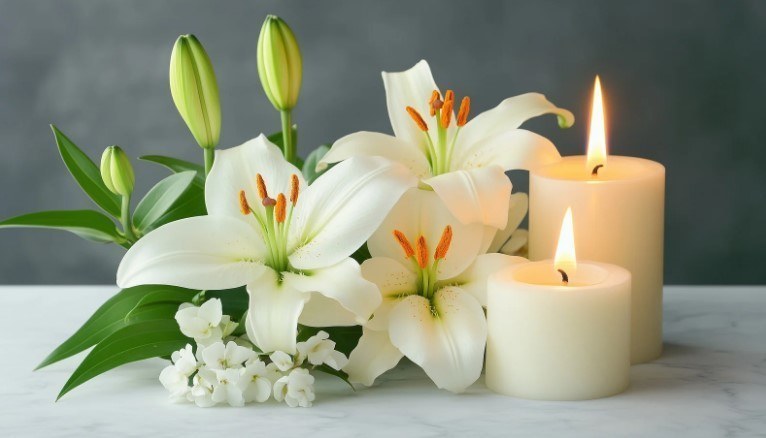
Flowers to skip: lilies (heavy fragrance and pollen that stains fabric), strongly scented hyacinths and gardenias, and anything with loose pollen. Many new mothers are sensitive to strong smells in the days after birth, and pollen does not belong near a newborn’s bassinet.
Color is a matter of taste rather than rule. Pink and blue remain popular, but neutral palettes of cream, white, blush, and soft green suit any family and avoid assumptions. Many parents now prefer the softer, muted tones that have become popular across the floral industry: pale pink, powder, lilac, and beige.
Where My Peonika fits in
For readers in South Florida, My Peonika is the florist I point people toward for new baby orders, and the reasons are specific rather than sentimental. Their new baby collection is built around exactly the guidelines above: the studio avoids strongly fragrant and high-pollen flowers like lilies and designs compact arrangements meant to fit on a hospital windowsill or a crowded nursery dresser. For parents of a girl, their flowers for new baby girl lean on pink roses, blush ranunculus, hydrangeas, and pink balloons, and the same collection includes neutral and white options for families who prefer to skip the color coding.
What I appreciate most is the practical packaging. Bouquets travel in an aqua hydration pack inside a protective box, so exhausted parents do not have to hunt for a vase the moment the doorbell rings. Each order includes flower food, care instructions, and a complimentary card, which is where all the wording in this guide comes in.
Price ranges to expect
Across the US, a modest new baby arrangement from a local florist typically costs somewhere in the range of $60 to $150 before delivery, with larger designs and gift sets going well above that. These are general estimates and vary by city and season. As a concrete reference point, the My Peonika new baby collection runs from about $110 for “Ethereal Dreams” (French roses and hydrangeas) and $131 for “Little Wonder,” through $163 for “Cute & Cozy” and $187 for the “Tender Pink Tranquility” box, up to gift sets like “Hello, Little One” at $257 to $490 and the “Welcome New Baby” set with balloons at $382 to $429.
- Coworker or acquaintance: a small bouquet in the $100 to $150 range, or a group gift.
- Close friend: $150 to $250, often with a practical add-on.
- Immediate family or first grandchild: a larger gift set or a statement arrangement, plus something lasting.
Practical gifts that pair well with flowers
Parents of newborns consistently say the most useful gifts are the ones that save time or reduce decisions. Ideas that pair naturally with a bouquet:
- A meal delivery or restaurant gift card for the first two weeks. Food is the single most appreciated gift for many new parents.
- A grocery delivery credit, so nobody has to leave the house for diapers and milk.
- A house cleaning session scheduled two to three weeks out.
- A plush toy, which becomes a keepsake long after the flowers are gone.
- A small comfort gift for the mother, such as tea, a nice water bottle, or a soft robe. The person who gave birth often gets overlooked.
- Something for older siblings, like a book or small toy, so the big brother or sister feels included.
Several florists sell add-ons that simplify this. My Peonika, for instance, offers plush toys, personalized cards, satin ribbons, and balloons with new baby orders, along with a giant teddy bear for $94 and a tea duo for $41, which is a thoughtful option for a mother who needs a quiet cup more than another pacifier.
Food: what to send and what to skip
Meals are often the best companion to flowers. A few guidelines:
- Ask about allergies and dietary restrictions, or choose a service that lets the parents order themselves.
- Send food in disposable containers so nobody has to return dishes.
- Freezer-friendly meals like soups, casseroles, and burritos are more useful than one large fresh dinner when five other friends are sending fresh dinners the same week.
- One-handed snacks (granola bars, nuts, cut fruit, muffins) are welcome during long feeding sessions.
- Skip elaborate dessert towers and anything that needs assembly.
Hospital Delivery Versus Home Delivery: The Etiquette
Where and when you send flowers can matter as much as what you write. Here is how to decide.
When hospital delivery makes sense
Hospital delivery is appropriate when all of the following are true: you know the hospital, the parent’s full name as registered, and ideally the room number; the maternity unit accepts flowers; and the family is likely to stay at least another day. Most uncomplicated vaginal births in the US result in a hospital stay of about 24 to 48 hours, while cesarean births typically mean two to four days. That window is short. A bouquet that arrives the afternoon the family is discharged is a bouquet they have to carry to the car along with an infant seat and three bags.
Before ordering, call the hospital’s main line or the maternity ward desk and ask two questions: are fresh flowers allowed on the postpartum unit, and are there restrictions on balloons? Latex balloons are banned in many hospitals because of allergy concerns, and some units do not allow balloons at all.
Hospital etiquette checklist
- Keep the arrangement compact. Hospital rooms have limited surface space, and nurses need room to work.
- Choose low fragrance and low pollen. Roommates and staff share the air.
- Never send flowers to a NICU or any intensive care unit.
- Use the parent’s legal name as registered at the hospital, not a nickname.
- Avoid glass vases that are large or heavy; a box arrangement or small vase travels home more easily.
Florists who deliver to hospitals regularly handle these details routinely. My Peonika delivers to Miami-area hospitals and designs its new baby pieces in a compact size for exactly this reason.
When home delivery is the better choice
For most situations, home delivery a few days after the family returns is the more considerate option. The flowers last longer in the family’s own space, parents can enjoy them without managing them in a cramped room, and your gift arrives after the first wave of hospital visits has passed, when attention and help usually drop off sharply.
Good timing for home delivery is roughly 3 to 10 days after the birth. Avoid the exact day of discharge. Coordinate with a partner or grandparent if you can, so someone is home to receive the delivery and the doorbell does not wake a sleeping baby. Many florists let you add delivery instructions such as “please knock softly, do not ring” or “leave with the front desk,” and it is worth using that field.
Practical Tips for Ordering New Baby Flowers Online
- Write your card message before you start the order. Draft it in your phone’s notes, read it once out loud, then paste it in.
- Check the character limit. Online forms often cap card text at 150 to 250 characters.
- Include the baby’s name only if it has been publicly shared.
- Add a phone number for the recipient so the courier can coordinate rather than leaving flowers on a hot porch.
- Order by the cutoff time for same-day delivery. My Peonika, for example, accepts same-day orders until 5 PM and delivers seven days a week, with free delivery on orders over $190 within 10 miles of the studio.
- Read the freshness policy. Some florists guarantee their flowers for a set period; it is useful to know before you order.
- Keep the receipt or confirmation in case the delivery address needs to change after the family is discharged.
For Miami-area families, delivery covers neighborhoods including Aventura, Brickell, Coral Gables, Miami Beach, Sunny Isles Beach, Hollywood, and Pembroke Pines, and you can browse the full range of arrangements and add-ons at https://mypeonika.com/.
Flower care tips to include for the parents
New parents will not research flower care, so arrangements that come with instructions help. The basics are simple enough to mention in a follow-up text if you want the bouquet to last:
- Trim about half an inch from each stem at an angle on arrival.
- Remove any leaves that sit below the waterline.
- Change the water every other day and recut stems every two to three days.
- Keep the vase away from direct sun, heating vents, and fruit bowls (ripening fruit releases ethylene, which shortens vase life).
- Place flowers out of reach of older siblings and pets.
Real Examples: Three Full Orders, Start to Finish
Seeing the whole picture together helps. Here are three illustrative scenarios showing how the card, the gift, and the delivery choice fit together.
Example 1: A coworker’s first baby
A team of eight wants to send something to a colleague who just had a daughter. They pool $20 each for a $160 budget, choose a compact pink-and-cream arrangement, and schedule home delivery for the following Monday, five days after the birth. The card reads: “Congratulations on the arrival of baby Clara! Wishing your family a calm and joyful start. With love from the whole Design Team.” They skip balloons because the colleague mentioned a cat that pops everything.
Example 2: A sister with twins in the NICU
An older brother wants to support his sister, whose twins were born at 33 weeks and will spend about three weeks in the NICU. Flowers are not allowed in the unit, so he sends a meal delivery gift card and a weekly grocery credit right away, then times a soft white and blush bouquet for the day the twins come home. The card says: “Welcome home, Leo and Sadie. You two made your mom and dad the bravest people I know. I’m on dinner duty for the next month. Love, Uncle Chris.”
Example 3: A best friend’s second child
A friend is having her second baby, a boy. The sender knows the older child, age three, has been anxious about the new arrival. She orders a mid-size neutral arrangement plus a plush toy addressed to the big sister, delivered to the home on day four. Card: “Welcome, baby Arlo! And congratulations to Maddie, the best big sister in Miami. Love you all, Jules.”
Frequently Asked Questions
What should I write on a new baby card if I don’t know the baby’s name yet?
Use “your little one,” “your new son,” or “your beautiful daughter.” For example: “Congratulations on the arrival of your little one! Wishing your family health and happiness.” Some families delay announcing a name for cultural or religious reasons, so it is always fine to leave it out.
Is it appropriate to send flowers to the hospital after a baby is born?
It can be, as long as the maternity unit allows flowers and you are confident the family will still be there when the delivery arrives. Call the hospital first. Never send flowers to a NICU. When in doubt, send to the home a few days after discharge.
How long after the birth can I send flowers?
There is no strict deadline. The first two weeks are traditional, but gifts that arrive in weeks three through eight are often especially appreciated because the initial attention has faded by then.
Which flowers are safest for a newborn’s home?
Roses, hydrangeas, ranunculus, lisianthus, and peonies are good low-pollen, low-fragrance choices. Avoid lilies, which are heavily scented, drop staining pollen, and are toxic to cats, a real concern in homes with pets.
How much should I spend on new baby flowers?
As a rough guide, $60 to $150 is typical for a coworker or acquaintance, and $150 to $300 for close friends and family. Prices vary by region. Pairing a modest bouquet with a meal or practical gift often means more than spending everything on flowers.

One Last Thought Before You Write
New parents receive a flood of attention in the first 72 hours and then, quite suddenly, very little. The card that stays on the fridge is usually the one that arrived when things got quiet, used the baby’s name correctly, and offered something real: a dinner, an errand, a promise not to expect a reply. Pick the message from this guide that sounds most like you, change one word so it sounds even more like you, and send it on a day when the family needs it rather than the day you remember.