Contents:
- How This Botty Fact-Check Was Conducted
- What Botty Is — and What It Is Not
- Does Botty Connect Through an API Key?
- Who Controls the Assets When Botty Trades?
- Inside Botty’s Ready-Made Strategies
- Spot and Futures Do Not Share a Risk Profile
- What Botty’s Historical Figures Actually Show
- Can Users Run Their Own Backtests?
- Is the Botty Fee Taken Only From Profit?
- What the DigVel Audit Confirms
- Team and Company Figures
- What Botty Reviews Show
- Is Botty Only for Experienced Traders?
- Is Botty’s Trade History Verifiable Onchain?
- Risks the Evidence Does Not Remove
- Final Botty Fact-Check Assessment
Botty is described in very different ways: as an automated crypto trading bot, as a service that connects through exchange API keys, and as a platform that takes a share of profits. Some of these descriptions match the current product, some refer to an earlier model, and some go further than the evidence allows. This Botty fact-check tests the most common claims against the supplied evidence and explains how far each conclusion can go.
How This Botty Fact-Check Was Conducted
The analysis relies on three groups of material: the current How Botty Works platform overview (2026), which covers the trading logic, connection model, risk controls and fees; the September 2026 investor presentation, which adds the strategy catalog, historical figures and company data; and public reviews on www.trustpilot.com, where the page shows 36 reviews with an average rating of 4.1 out of 5, of which 30 were visible and analyzed.
Current documentation takes priority over older descriptions and individual reviews. Each claim receives one of these assessments: Confirmed by current documentation, Company-reported, Supported by an independent audit, Outdated description, Insufficient evidence or Unsupported conclusion.
What Botty Is — and What It Is Not
Claim: Botty predicts where the market will move.
The documentation says the opposite: Botty does not try to forecast direction and instead works with price movement itself. The user chooses the asset, the strategy and the amount; the system calculates an order grid in advance, adds larger orders as the price falls, lowers the average entry price and closes the whole position once the price returns above that average by a set step. The cycle then restarts. Unlike a classic grid bot with equal steps, the spacing and size of each order are calculated individually for how BTC, ETH and SOL move.
Assessment: Confirmed by current documentation. The current materials describe Botty as an automated strategy-execution platform rather than a market-prediction, signal or copy-trading service. It is also not an exchange, bank, broker, fund or custodial wallet. The idea that the system “knows” market direction is an unsupported conclusion.
On assets, the investor presentation focuses on BTC, ETH and SOL, while How Botty Works states that templates are built around fundamentally strong crypto assets and equities. The supplied strategy catalog lists only crypto templates, so stock support is referenced in current materials, but specific stock templates are not detailed in the evidence.
Does Botty Connect Through an API Key?
Several reviews describe connecting through an exchange API or “trade-only keys.” This does not match the current documentation. According to How Botty Works, the platform is integrated with Hyperliquid through the official Builder Code mechanism, confirmed with a single crypto-wallet signature. Botty receives permission to execute trades but not to withdraw funds, and that restriction is enforced at the exchange level rather than simply promised. The presentation adds that access can be revoked at any time, stopping the bot immediately.
Assessment: Outdated description. The claim that the current connection model requires an API key is outdated. Current materials describe authorization through a wallet signature and Hyperliquid Builder Code; API references in reviews most likely reflect an earlier version of the product.
Who Controls the Assets When Botty Trades?
Both current documents state that capital is never transferred to Botty. Funds are not moved into a fund, pool or separate account; they remain in the user’s own Hyperliquid account, and Botty acts as a technology layer that places and closes orders. Because Hyperliquid is a decentralized exchange, relevant trading activity is recorded onchain and the trade history is publicly verifiable.
Assessment: Confirmed by current documentation. The materials support four points: no deposits are accepted, no withdrawal permission is granted, the assets are not held by the platform, and Botty works only through authorized trading actions.
“Botty cannot withdraw users’ assets” does not mean “trading is risk-free.” Assets can still lose value and leveraged positions can be liquidated; the non-custodial model answers the question of custody, not market risk.
Inside Botty’s Ready-Made Strategies
The current materials describe three template categories:
Conservative: spot trading without leverage;
Balanced: futures with a wider grid, fewer trades and better tolerance of deep drawdowns;
Aggressive: futures with a tighter grid, more frequent trading and higher sensitivity to sharp moves.
The September 2026 presentation lists nine strategies, one per category for BTC, ETH and SOL. Both documents state that experienced users can also build their own configurations instead of using a Botty template. Assessment: Confirmed by current documentation.
Spot and Futures Do Not Share a Risk Profile
Spot templates buy the real asset; if the price falls below the grid, the user keeps holding it and there is no liquidation. Futures templates trade a leveraged contract, so liquidation becomes possible if the price runs past the grid without pullbacks and margin is insufficient. The documented controls include leverage limits, a default 50/50 split between capital at work and reserve margin (at least 50% stays in reserve), visible headroom, real-time monitoring and stress-scenario warnings. The presentation’s example: the Balanced ETH strategy at 50/50 could be liquidated only after a decline of roughly 67% without a pullback.
The presentation also states that adjusting the split can fully exclude liquidation risk. That strongest wording is a company statement; the platform overview describes liquidation as “possible, manageable” and says a larger reserve reduces its probability. Assessment: Unsupported conclusion if read as an absolute. The documentation distinguishes clearly between an unleveraged spot strategy and leveraged futures strategies with additional controls and additional risk.
What Botty’s Historical Figures Actually Show
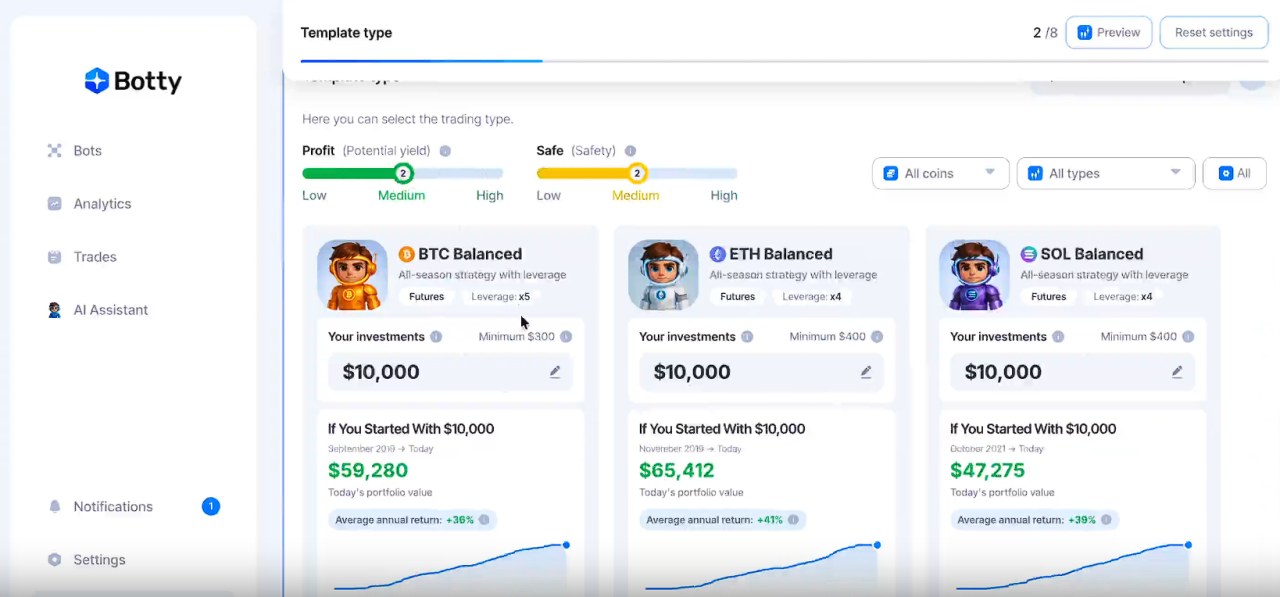
Every ready-made template displays pre-calculated historical data before launch: results by year and month, maximum drawdown, shortest, average and longest time in a trade, headroom and the grid itself. The grids use at least five years of market history; in the presentation, data periods start between 2018 and 2023 and run through 2026. (The presentation’s “8+ years” wording applies only to the longest periods.)
The historical average annual figures shown for Botty’s ready-made templates range from approximately 8% to 58%, depending on the asset, strategy category, parameters and testing period, with the Conservative spot templates at the lower end.
Assessment: Confirmed by current documentation that these figures are displayed. The claim that they guarantee future performance is an unsupported conclusion: both documents state that past results do not guarantee or predict future ones, and the figures do not show what any individual user earned.
Can Users Run Their Own Backtests?
Two reviews describe running one’s own backtests on the platform. The current public version of Botty offers no separate tool for arbitrary user-operated historical testing with custom settings; users see the pre-calculated figures attached to the templates. Assessment: Outdated description.
Is the Botty Fee Taken Only From Profit?
Several reviewers wrote that Botty charges only on successful trades or takes a commission from results. Current documents describe an activity-based fee instead. Its charge is incorporated into the Hyperliquid trading fee through Builder Code and applies when the relevant trading operation is executed. If the bot does not trade, no fee is charged. There is no subscription, no capital-management fee, no share of profits and no withdrawal fee charged by Botty.
The platform overview adds that Botty does not debit the fee from the account and could not, lacking withdrawal permission.
Assessment: Outdated description. Reviewers who noted the absence of a subscription are, however, consistent with current documentation.
What the DigVel Audit Confirms
According to How Botty Works, Botty underwent an independent security audit by DigVel, which takes no part in building it. The certificate covers penetration testing of botty.com, is dated April 21, 2026, and the results can be checked on DigVel’s website; the presentation adds that all identified issues were closed.
Assessment: Supported by an independent audit. The broader statement about regular audits is company-reported, with DigVel as the documented example. An audit reflects the system at the time of testing, not all future technical risks.
Team and Company Figures
The investor presentation names Oleksii Ostapovskyi as founder and states that Botty launched in March 2026. The September 2026 presentation reports a team of 31 people, approximately $3.35 million in capital at work and 214,088 closed trades in the first five months. Company materials also cite a previous educational project with more than 40,000 graduates.
Assessment: Company-reported. These are time-specific figures from Botty’s own materials. Independent confirmation was not supplied, so they should be read as of September 2026 rather than as verified current statistics.
What Botty Reviews Show
The 30 visible reviews form a small sample, and its size and composition do not support statistically representative conclusions about all users. Recurring themes include:
Time savings: the bot runs during full-time work, long-haul driving, maternity leave or a vacation, with balances checked weekly rather than every few minutes;
Less emotional trading: several users say automation stopped panic selling or attempts to win back losses;
Asset control: funds stay on the user’s own account without withdrawal rights for the platform;
Modest results: outcomes described as slow, steady or “boring but real”; one reviewer reports about 29% across four bots over eight months, an individual account rather than a typical outcome;
Usability: a clear dashboard and AI assistance.
Some users note that Botty suits a calm, passive style rather than people seeking high gains. These experiences are reflected in individual user reviews and align with the documentation. Automation can reduce emotional interference, but it cannot stop a user from choosing an unsuitable strategy.
Is Botty Only for Experienced Traders?
Claim: Botty can be used only by people who already know how to build and manage trading strategies.
The current materials describe a product designed to reduce manual configuration. Ready-made templates mean the user does not have to build an order grid; the user chooses an asset, a template that fits the desired level of risk and the amount of capital, then presses “Launch.” According to How Botty Works, a user with an existing wallet can complete this in a few minutes, and someone starting from scratch is guided through each step with instructions, an AI assistant and the support team. Personal onboarding with the team is described for those allocating significant capital, while experienced users keep the option of building their own configurations.
Assessment: Partially confirmed in its reverse form. The materials support a limited conclusion: the platform is designed so that users do not need to build strategies themselves, and templates, guided connection and AI explanations make parameters easier to understand. The evidence does not show that market knowledge is unnecessary or that the product suits everyone. A user still chooses between unleveraged spot and leveraged futures, sets the amount and accepts the documented risks.
Is Botty’s Trade History Verifiable Onchain?
Claim: Trades executed through Botty can be checked independently rather than taken on trust.
How Botty Works states that Hyperliquid is a decentralized exchange where trading operations are recorded onchain, which makes the history of trades and operations publicly verifiable. Since capital stays in the user’s own account, the orders appear in that account’s record rather than an internal ledger. The investor presentation adds that the founder trades through the same automations offered to clients and lists three active ones (BTC, ETH and HYPE) with Hypurrscan explorer addresses showing trade history, open positions and current PnL.
Assessment: Confirmed by current documentation. Public verifiability means a specific account’s activity can be inspected; it does not make the founder’s automations a typical user outcome or turn historical template figures into a forecast.
Risks the Evidence Does Not Remove
None of the documented features make automated trading through Botty risk-free, and the materials themselves state that trading carries a risk of losing capital.
Results depend on market conditions and parameters; lower volatility means fewer trading cycles.
Historical figures do not guarantee comparable future performance.
Futures templates use leverage and carry real liquidation risk; spot assets can still decline in value.
An open position can remain in drawdown for days or weeks.
Individual reviews do not predict another user’s outcome.
Final Botty Fact-Check Assessment
What can be established with confidence is the architecture: Botty is an automated execution layer connected to Hyperliquid through a wallet signature and Builder Code, with trading rights only, assets in the user’s own account, publicly verifiable onchain records and an activity-based fee, plus an independent DigVel penetration test. Older descriptions involving API keys, profit-sharing fees and user-run testing no longer match the product. Company figures date from September 2026. Reviews point to time savings, calmer trading and modest results, but cannot predict anyone else’s outcome. Every claim about Botty is best read in that context.